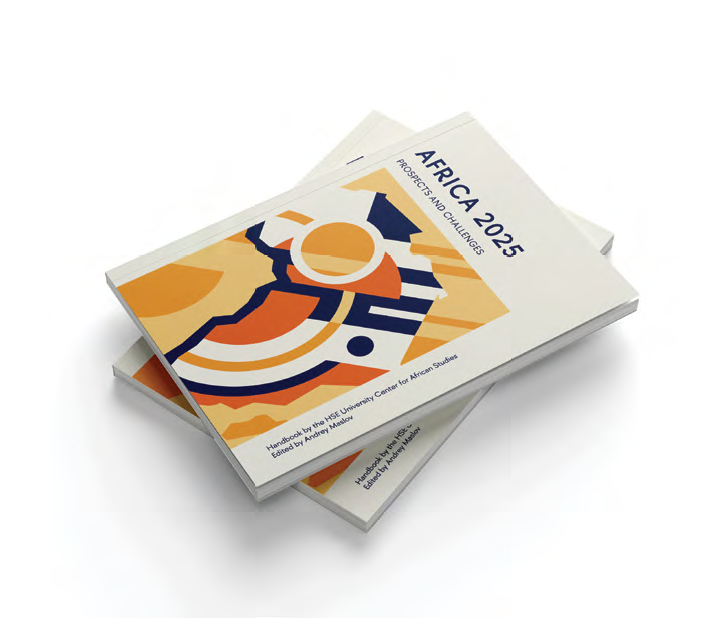
Africa 2025: Prospects and Challenges is to serve as a handbook on Africa’s development, challenges and opportunities. Its target audience includes government officials, businessmen, scholars and experts. The handbook aims to provide alternative positive vision on some issues that Africa faces, among them being fight for food and energy sovereignty, debt crisis, digital transformation, rapid urbanisation and population growth.
The book was prepared by the team of experts and scholars coordinated by the HSE University Center for African Studies (Moscow, Russia).
Full text:
Africa 2025: Prospects and Challenges (PDF, 8,55 Мб)
Сhapter 1. Measuring Africa’s wealth and money
The chapter Measuring Africa’s wealth and money examines the financial framework of African countries, whose main attributes - high debt burden and deep trade imbalances - are seen as interdependent phenomena. The chapter uses both well-known and author’s indicators to categorise African states by debt sustainability. It discusses currency regimes in detail, opening a discussion on the reserves of African countries, where they are held, under what conditions, and whether their management policies align with real economic development needs.
The chapter serves as an integral part of the handbook Africa 2025: Prospects and Challenges prepared by the HSE University Center for African Studies.
Measuring Africa’s wealth and money (PDF, 1,36 Мб)
Chapter 2. Food to Africa: From Food Security to Food Sovereignty
Chapter Food to Africa: From Food Security to Food Sovereignty deals with the most pressing food-related issues in Africa, including the correlation between population growth and undernourishment, Africa’s role in global food markets, changes in dietary patterns, the role of fertilizers, etc. The chapter proposes the concept of food sovereignty and analyses cases of African governments supporting food and beverages and agricultural sectors.
It serves is an integral part of the handbook Africa 2025: Prospects and Challenges prepared by the HSE University Center for African Studies
Food to Africa: From Food Security to Food Sovereignty (PDF, 955 Кб)
Chapter 3. African resources to African markets: making mining and energy work for Africa
The chapter African resources to African markets: making mining and energy work for Africa addresses key energy challenges in Africa, analysing electricity generation market structures and providing with regional and country-specific forecasts. It includes one of the first discussions on the ‘shadow generation’ market in Africa — a network of small diesel generators that satisfy a significant portion of the electricity demand from households and small businesses. The chapter emphasises the balance between developing domestic markets and increasing exports, between national businesses and multinational corporations, and explores the prospects and challenges for African countries posed by the energy transition.
The chapter serves as an integral part of the handbook Africa 2025: Prospects and Challenges prepared by the HSE University Center for African Studies.
African resources to African markets: making mining and energy work for Africa (PDF, 1024 Кб)
Chapter 4. African quest for digital sovereignty
The chapter African quest for digital sovereignty offers a broader understanding of digital sovereignty, going beyond data circulation and infrastructure control. It notes that digitalization presents an opportunity for African countries to address pressing socio-economic issues, highlighting the growing need to create frameworks for sovereign development of the sector. The chapter provides unique assessments of foreign influence on digital transformation process and the role of corporations, where African data is stored and websites hosted. The role of African languages in enhancing the social impact of digitalization is explored, with the first evaluation of the availability of African languages on government websites.
The chapter serves as an integral part of the handbook Africa 2025: Prospects and Challenges prepared by the HSE University Center for African Studies.
African quest for digital sovereignty (PDF, 4,53 Мб)
Chapter 5. Education is power: who teaches African leaders
The chapter Education is power: who teaches African leaders presents a detailed analysis of the current state of the education sector and the problems facing African countries, and its prospects. The chapter examines in detail the influence of external actors on education, and the link between foreign educational assistance and the migration of highly qualified professionals out of Africa. It includes research on the budgets of leading African universities and the educational backgrounds and languages spoken by high-level public officials and statesmen.
The chapter serves as an integral part of the handbook Africa 2025: Prospects and Challenges prepared by the HSE University Center for African Studies.
Education is power: who teaches African leaders (PDF, 1,13 Мб)
Chapter 6. Image of Africa in the mirror of think tanks around the globe
The chapter Image of Africa in the mirror of think tanks around the globe considers opinion and assessment of cooperation with Africa by experts from all over the world. This chapter relies on a qualitative analysis of more than 300 articles that were published by think tanks in 2024 and the second half of 2023. The author calculates an ‘attention index’ to Africa relative to other regions and analyse how Africa is viewed within frameworks like ‘Africa as a source of risks vs. a source of opportunities’, ‘security vs. economy’, and ‘humanitarian projects vs. trade and business’.
The chapter serves as an integral part of the handbook Africa 2025: Prospects and Challenges prepared by the HSE University Center for African Studies.
Image of Africa in the mirror of think tanks around the globe (PDF, 749 Кб)
Chapter 7. Identifying the DNA of African сreativity
The chapter Identifying the DNA of African сreativity highlights the development of the continent’s creative industries. It presents unique market volume assessments across several countries in an industry that employs 2 million people in Africa. Amid a growing need for self-representation in telling African stories, cultural narratives created by Africans themselves are gaining popularity. The chapter illustrates the significance of cultural sovereignty and the role digitalisation plays in achieving it, encompassing both historical heritage and modern creative forms such as music, film, and fashion.
The chapter serves as an integral part of the handbook Africa 2025: Prospects and Challenges prepared by the HSE University Center for African Studies.
Identifying the DNA of African сreativity (PDF, 235 Кб)
Chapter 8. African businesses – the emerging regional and global players
The chapter African businesses – the emerging regional and global players considers African business and its connection with the growth trajectory and development of the continent’s countries. The authors offer a description of the current situation in African business as a phenomenon with unique specificity, and also analyse factors affecting the ability of companies to transform their business model from a locally oriented one towards building connections that allow them to compete at the regional and, in some cases, global levels. This analysis helps to classify the African business landscape and, moreover, it calls into question the Western narrative about economic liberalization as a priority factor that provides businesses with the opportunities. The chapter also shows how the growing transnationalisation of business processes in Africa is creating new opportunities for local companies.
The chapter serves as an integral part of the handbook Africa 2025: Prospects and Challenges prepared by the HSE University Center for African Studies.
African businesses – the emerging regional and global players (PDF, 513 Кб)